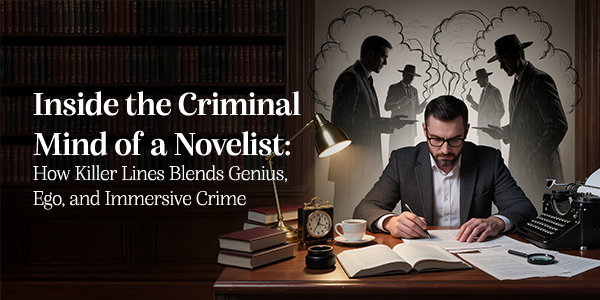
In most crime thrillers, the criminal is someone trying to avoid exposure. Their actions are hidden, desperate, reckless, or reactive. They operate in the shadows and hope the world never learns their name.
But in Killer Lines, the criminal is already famous.
His name is Ved, and millions know his face—not from police files, but from book covers, interviews, and televised charity galas. His signature is printed on novels that sit in living rooms and airport bookstores around the world.
Yet the most shocking part isn’t that Ved is secretly orchestrating crimes—it’s that the world celebrates every one of them without knowing it.
Crime as Creativity
Ved doesn’t commit crimes out of rage, impulse, or financial desperation. His motives are more unsettling—and more fascinating.
For him, crime is:
- artistry
- control
- narrative experimentation
- the ultimate form of authorship
Every flawless operation is treated like a draft. Every disappearance becomes a subplot. Every success is immortalized as literature.
This makes Ved one of the most original anti-heroes in modern fiction, not a villain who hides from his actions, but one who curates them.
He doesn’t just rewrite the rules.
He rewrites reality, then publishes it.
Feldmann: The Only Mind That Matches His
Across Europe, investigators are stumped by crimes that leave no trace. But one man notices what others overlook.
Feldmann, the brilliant, enigmatic investigator, isn’t driven by ego or fame. His gift is uncomfortable intuition, the ability to sense patterns long before evidence appears.
For years, Feldmann has been unknowingly trying to catch a man the world applauds. He follows elegance where others seek motive. He studies silence where others look for noise.
But the twist that elevates the series is this:
Feldmann isn’t simply hunting Ved.
He is drawn to him.
Their dynamic is not hero vs. villain.
It’s recognition.
Each represents the only worthy opponent the other has ever found. Their duel is fueled by respect, fear, intellectual seduction, and a growing awareness that neither can walk away without losing something essential.
A Thriller That Explores Identity, Power, and Obsession
The series steps beyond plot into psychological depth. It asks questions other thrillers avoid:
- What happens when genius erases morality?
- How does admiration become obsession?
- Why do we trust people who make us feel safe instead of people who tell the truth?
- Can you be both admired and monstrous at the same time?
Ved and Feldmann are not opposites, they are mirrors.
One commits crimes and writes them into fiction.
The other solves crimes and reads between the lines.
Their collision is inevitable, not because one must win, but because neither can stop.
Dark Humor with Razor-Sharp Precision
Though the stakes are serious, the series embraces dark, intelligent humor:
- The public praises Ved’s “realism” without knowing how real it is.
- Feldmann analyzes crime scenes described in books he bought at the airport.
- Fans obsess over plot twists that were once police reports.
It is satire without slapstick, humor rooted in human blindness.
The result is a tone that is:
- sophisticated
- unsettling
- smartly cynical
- wickedly entertaining
Readers laugh—not because it’s funny in a lighthearted way, but because the truth is uncomfortably recognizable.
Why Adult Readers Can’t Put It Down
The series is designed for adult readers 18+ who crave:
- complexity over clichés
- intellect over shock value
- tension rooted in psychology, not gore
- villains who aren’t villains in their own minds
It appeals to anyone tired of formulaic crime fiction and ready for stories that challenge certainty, loyalty, and even morality.
The Most Dangerous Part of the Story
Most thrillers end when the criminal is caught or the truth is revealed.
But Killer Lines asks a more disturbing question:
What if the world prefers the lie?
Ved doesn’t hide because he doesn’t have to.
People don’t see the truth, not because it’s invisible, but because it’s inconvenient.
And that is what makes this series unforgettable.
It’s not just about crime.
It’s about the stories we believe, the people we trust, and the terrifying possibility that the most dangerous monsters are the ones we admire.